Deepen media cooperation between China and Kyrgyzstan to jointly create a bright future for SCO
Chinese President Xi Jinping has pointed out that interactions between civilizations provide the most solid foundation for the Shanghai Cooperation Organisation's (SCO) development, and people-to-people exchanges provide the strongest driving force for the organization. Kyrgyzstan will host this year's summit, which marks the 25th anniversary of the founding of the SCO.
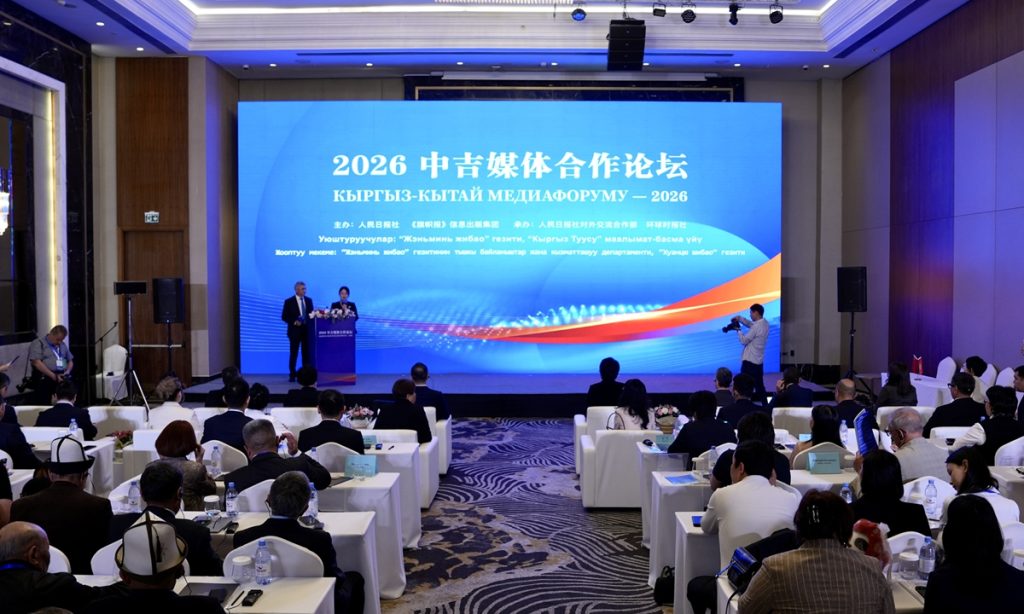
On May 27, the 2026 China-Kyrgyzstan Media Cooperation Forum, themed "Deepening China-Kyrgyzstan Media Cooperation for a Brighter SCO Future," was held in Bishkek, the capital of Kyrgyzstan. Nearly 100 media representatives, officials from relevant departments, experts, scholars and business representatives from China and Kyrgyzstan attended the forum, engaging in in-depth exchanges and discussions on topics including economic and trade development, cultural exchange and media cooperation. The forum was jointly hosted by the People's Daily and Kyrgyz Tuusu Publishing House.
Media in unity, building consensus for development
"Amity and good-neighborliness are invaluable to a country." Linked by mountains and rivers, China and Kyrgyzstan are good neighbors, good friends and good partners enjoying close people-to-people ties. In recent years, under the strategic guidance of the two heads of state, the China-Kyrgyzstan comprehensive strategic partnership for a new era has maintained a strong momentum of development. Media outlets from both countries have played an active role in promoting the building of a closer SCO community with a shared future and a China-Kyrgyzstan community with a shared future.
Cui Shixin, Deputy Editor-in-Chief of the People's Daily, said that holding the China-Kyrgyzstan Media Cooperation Forum is both an implementation of the important consensus reached by the two heads of state on deepening the China-Kyrgyzstan comprehensive strategic partnership for a new era, and a concrete action to create a favorable public opinion environment and lay a solid public foundation for the upcoming Bishkek SCO Summit. China and Kyrgyzstan are companions on the path to modernization. Media of both countries should build consensus on development to anchor mutual trust, boost mutually beneficial cooperation to pave the way for prosperity, deepen cultural exchanges to nurture the tree of friendship and consolidate institutional foundations to amplify the voice of the SCO. With a constructive attitude, they should build bridges of understanding, present a true, multidimensional and comprehensive picture of China-Kyrgyzstan cooperation, and tell vivid stories of mutually beneficial cooperation between the two countries.
Salkyn Sarnogoeva, Deputy Minister of Culture, Information, Sports and Youth Policy of the Kyrgyz Republic, said that the friendship between China and Kyrgyzstan has a long history, and the spirit of the Silk Road has firmly bound the two peoples together. In the digital era, media are a bridge connecting the peoples of the two countries, and it is very important for the two sides to strengthen media exchanges and cooperation. At present, the SCO is in a period of vigorous development, and the media of both countries should jointly respond to the challenges posed by fake news and information disorder, learn from each other in areas such as artificial intelligence applications, creative industry development, and media platform building, and support the growth and development of young journalists.
Since its founding, the SCO has always upheld the Shanghai Spirit of mutual trust, mutual benefit, equality, consultation, respect for diverse civilizations and pursuit of common development. It has become the world's largest regional cooperation organization in terms of population, geographic area and development potential.
Galina Baitekerek, head of Kyrgyz Tuusu Publishing House in Kyrgyzstan, said that the SCO is becoming an important platform for different civilizations to strengthen dialogue and mutual respect. Strengthening cooperation between Chinese and Kyrgyz media in various fields will help establish an objective image of SCO member states internationally and is of great significance for promoting the development of the SCO. The two sides have broad prospects for cooperation in many areas, including promoting exchanges of experience between journalists and experts, creating joint media projects, advancing digital platforms and new media development, and increasing support for young journalists.
Sun Dapeng, counselor of the Chinese Embassy in Kyrgyzstan, said that media play an irreplaceable role in deepening mutually beneficial cooperation and promoting people-to-people affinity. Media cooperation is also a key direction of SCO cooperation and China-Kyrgyzstan cooperation. This forum is another important achievement of China-Kyrgyzstan media cooperation. He hopes that media from both countries will continue to deepen cooperation, firmly promote the Shanghai Spirit, introduce successful experiences in SCO development, show the bright prospects of cooperation among countries and tell the "SCO story" well.
Mutual benefit and win-win outcomes, broadening path of cooperation
Civilizations become colorful through exchange, and cooperation becomes profound through pragmatism. At the forum, guests from the tourism, aviation, logistics, automotive and technology sectors of both countries shared cooperation achievements and discussed future visions, painting a vivid picture of coordinated development and mutual benefit across multiple fields between China and Kyrgyzstan.
Eduard Kubatov, Director of the State Agency for Tourism Development of Kyrgyzstan, said that China-Kyrgyzstan relations are currently at their best in history, with political mutual trust, economic and trade investment, and cultural exchanges continuing to deepen. Tourism cooperation is an important part of the bilateral friendship. The two sides have already opened direct flights and are actively 8ancient city of Suyab), and will also work with Uzbekistan to build an international tourism hub. He said Kyrgyzstan is willing to take this forum as an opportunity to work with China to advance tourism and cultural cooperation and jointly promote the continued development of bilateral relations.
A representative from Air China's Bishkek office said that Air China will officially enter the Kyrgyzstan market. Earlier media reports indicated that Air China will launch a direct flight between Beijing and Bishkek starting July 17. The opening of this route will pave a smoother "air Silk Road" for personnel exchanges and economic and trade cooperation between the two countries, and the bilateral passenger flow is expected to exceed 200,000 for the first time this year.
Deputy General Director of "Kyrgyz Post" JSC, Uulzhan Masiyanova, said that Kyrgyzstan and China are engaged in close cooperation in political, economic, logistics, digital technology, information and communications, and cultural fields. In particular, cooperation in cross-border e-commerce and logistics has become one of the vivid examples of practical cooperation between the two countries. Their cooperation is reflected not only in the extension of roads and the growth of trade, but also in the integration of information spaces, mutual understanding in the media sector, and deeper awareness and understanding between the peoples of the two countries.
In his remarks, Lu Yunran, CEO of 212 Off-Road Vehicle Co., Ltd., shared the story of how 212 became a flagship independent Chinese off-road model. He said that China's complete industrial and supply chain system, the creativity of millions of engineers and the breakthroughs made by Chinese automobiles in the new energy and intelligent era have provided a solid technological foundation and a broad stage for Chinese brands to go global. At present, 212's global sales network covers more than 80 countries and regions. In the future, the company will deepen cooperation with partners in Central Asian countries and work together with all parties under a "Chinese technology + local market" model.
Ulanbek Satiev, General Director of the National Television and Radio Broadcasting Corporation of the Kyrgyz Republic (NTRK), said that while NTRK has been deeply cultivating traditional television media, it has also built a strong influence on new media platforms. At present, NTRK is also actively embracing cutting-edge technology and has officially introduced artificial intelligence to broadcast daytime news.
Li Dahai, CEO of Beijing MODELBEST Technology CO., LTD, said that artificial intelligence is not only a new round of technological revolution, but also a new development channel, and should become an inclusive infrastructure for common development among countries. Relying on key laboratories and an open-source ecosystem, ModelBest AI has already established the technical chain for "sovereign large models" and created a sample of an intelligent foundation. He looks forward to working with partners in Kyrgyzstan and other Central Asian countries to make AI better understand local languages, be closer to local industries and better serve local people.
People-to-people exchanges, painting picture of future together
Ideas collide to gather wisdom, and dialogue deepens friendship. In the roundtable discussion session of the forum, guests engaged in in-depth exchanges on the topic of "Media building bridges of people-to-people exchanges and empowering cooperation and development between the two countries," sharing experiences, building consensus and offering suggestions to improve the quality and effectiveness of China-Kyrgyzstan media cooperation.
Guan Kejiang, President and Editor-In-Chief of the Global Times, said that language is a bridge for communication, and media can use each other's languages to better tell the stories of their own development, China-Kyrgyzstan cooperation, SCO cooperation and the Global South. This is the proper mission of the media.
Du Hua, Director of the Confucius Institute on the Chinese side at Bishkek State University, has worked in Bishkek for seven years. She said that Chinese brands can be seen everywhere in Bishkek, and the idea of mutual benefit and win-win cooperation has taken root in people's hearts. The media are witnesses and communicators of friendly cooperation, and young students can deepen their understanding of each other's cultures through the media.
Kurmanbek Mambetov, a commentator for Kyrgyz newspaper Kyrgyz Tuusu, said he hopes the media will focus more on practical cooperation projects between Kyrgyzstan and China, such as Chinese investment in Kyrgyzstan, technological cooperation and tourism exchanges, so as to enhance mutual trust and promote cooperation. At the same time, the media need to embrace new technologies to better meet the information needs of local audiences.
Ismail Dairov, an international commentator for Slovo Kyrgyzstana, has long promoted environmental protection ideas through the media. He said China has made great achievements in the field of new energy, and the prospects for cooperation between Kyrgyzstan and China are broad. The Kyrgyz side hopes to learn from China's technological experience to support local green development.
At the end of the forum, Kubat Chekirov, head of the "Kut Bilim" media center, told the Global Times that "as journalists, when we convey new knowledge, new trends and new developments from the other country to our own people, cooperation between the two countries will become closer, and mutual understanding will be further deepened."
As the tide rises over the Tianshan Mountains and the wind fills the sails, hearts and hands joined together move toward the future. Standing at the new starting point of the 25th anniversary of the founding of the SCO, the media of China and Kyrgyzstan will continue to carry forward the Shanghai Spirit, fulfill their media mission, and use the pen as a medium and the camera as a bridge to tell the story of China-Kyrgyzstan friendship and spread the voice of the SCO.