A flash flood triggered by intense short-duration rainfall in Weiyuan county, Northwest China's Gansu Province, killed 10 people and injured 23 on Sunday. Four rounds of search and rescue operations had been conducted, according to media reports.
The flood struck Shuangshimen valley in Huichuan township at around 2 pm on Sunday, after heavy rain upstream caused water levels to surge, trapping nearby campers and sweeping away vehicles parked along the riverbank. Local authorities immediately deployed emergency, firefighting, health and tourism personnel to carry out rescue operations and evacuations, according to China Central Television (CCTV) News.
A total of 305 firefighters, 68 fire engines and four search-and-rescue dogs were sent to the scene, with 247 stranded people evacuated or relocated.
Following the disaster, China's State Flood Control and Drought Relief Headquarters and the Ministry of Emergency Management dispatched a working group to guide the response and activated a level-IV emergency response for flood control in Gansu, according to chinanews.com.cn.
A witness recalled that the weather changed with extraordinary speed around noon. "Within just over 10 seconds, torrential rain began pouring down, accompanied by dense hail," the witness said. Water levels in rivers near the scenic area rose rapidly, and vehicles parked along the riverbank were swept away by the floodwaters.
This year marks the 105th anniversary of the founding of the Communist Party of China (CPC). Over the past century, the Party has led China through profound transformations: from national peril to national rejuvenation, from bare subsistence to moderate prosperity, from technological catch-up to independent innovation and from isolation and underdevelopment to greater educational equity. Generation after generation of CPC members, through their unwavering commitment, have written an epic of uplifting the destiny of the Chinese nation, the well-being of its people and the course of national development.
July 1 marks the CPC's founding anniversary. On this occasion, the Global Times is launching a special series, "105 Years of Uplift," to explore the deeper answer to the question of why the CPC has succeeded. The second installment looks at how, in the face of extreme weather, the Party supported farmers to save a wheat harvest and, in doing so, upheld the fundamental promise of food security for hundreds of millions. The sky had turned overcast again. Wang Yongzhong looked up at the gathering mass of gray clouds. A wind blew in from the fields, carrying the scent of ripening wheat - and with it, a trace of anxiety.
More than 66.7 hectares of Wang's wheat were still standing in the fields, while the weather forecast warned that a new round of torrential rain was heading toward his home in Xiangyang, Central China's Hubei Province.
Since mid-May, more than 300,000 hectares of wheat in Xiangyang had ripened all at once, only to be met by a rare spell of consecutive rainy days. According to local media reports, if the crop was not harvested urgently, a year's worth of farmers' hard work could go to waste - affecting the livelihoods of countless farming families involved, and, more fundamentally, posing a threat to the nation's food security.
But Wang, like many other farmers in Xiangyang, did not have to worry for long. Before the wheat harvest began, meeting rooms in many grassroots CPC organizations across the city were brightly lit as the Party members and officials discussed how to better help farmers bring in the crop. Local power utility workers also inventoried lighting equipment and prepared to head into the wheat fields through the night. Also, hundreds of kilometers away, combine harvester operators from across the country started their engines as they received calls for help from Xiangyang.
In the end, the race against the downpour - a "battle" to save the grain - was won through the efforts of all sides. Local farmers' anxiety gave way to the steady reassurance of a bumper harvest.
In Wang's eyes, it was numerous hands, lights and roaring machines that together uplifted the bowls of rice in Xiangyang safely out of the rain.
"If it hadn't been for the support of the Party and the government, and the help that came from all directions, my wheat might still be stuck in the mud right now," Wang told the Global Times.
A three-day and two-night 'battle'
Wang is a grain farmer in Nanzhang County of Xiangyang. Nestled in the rolling hills of northwestern Xiangyang, Nanzhang depends heavily on wheat, which is one of the key sources of annual income for local farm households.
In Xiangyang, the wheat crop had been looking exceptionally strong this year, raising hopes for a bumper harvest. But in mid-May, several days of continuous rain arrived. Mature wheat ears were soaked in the downpour, and the risks of lodging, sprouting and mildew rose by the day. Wang paced back and forth at the edge of his fields, anxious and restless. He knew all too well that, if the harvest were delayed any longer, a season's worth of hard work could come to nothing.
He was not alone in his worry. Across Xiangyang, a total of 357,000 hectares of wheat might face the same fate.
"We could see the golden heads of wheat in the fields, but we couldn't harvest them. That made us anxious," recalled Liu Fan. As Party secretary of Huanglong Town in Xiangyang, he felt the pressure immediately: if the town's more than 8,000 hectares of wheat could not be harvested on time, yields would fall, and the price of sprouted wheat would also drop sharply.
Everyone was waiting for the rain to stop. Finally, the local meteorological department identified a precious window: from May 21 to 23, a stretch of three days and two nights with no rain, possibly the only chance to rush the wheat harvest.
"At that point, we decided to make the most of those three days and two nights," Liu told the Global Times.
A 72-hour wheat-harvest "battle" unfolded across Xiangyang's briefly clear skies.
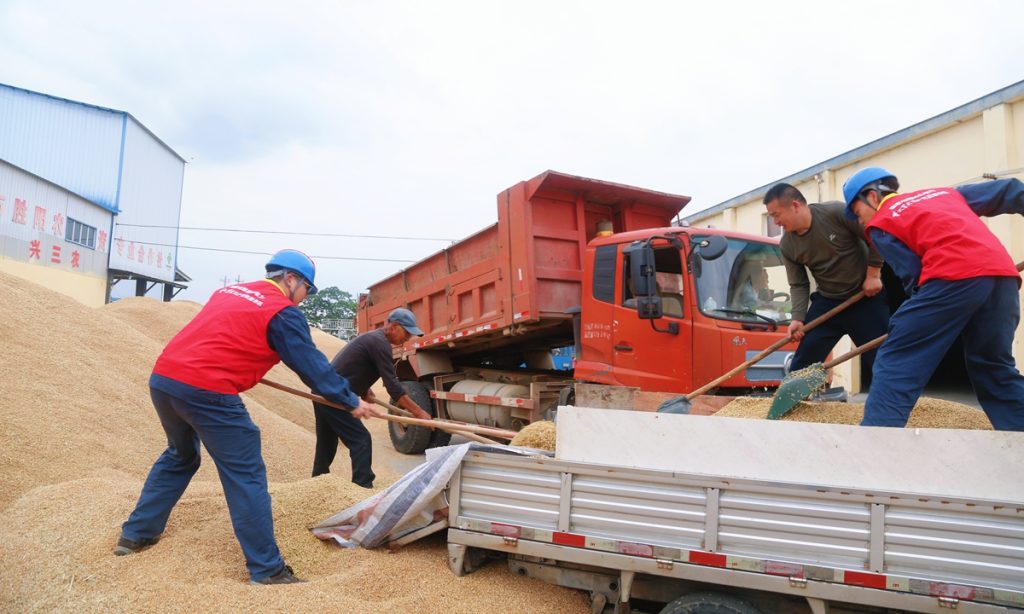
In Huanglong Town, grassroots Party members and officials worked together to clear field roads and dredge drainage ditches, ensuring farm machinery could get into the fields. The town also opened many public facilities, providing a place for the more than 170 combine harvesters that arrived from outside the region to rest, as well as hot and cold showers and free daily necessity kits.
"During those days, there was no such thing as clocking in or out. Wherever there was a need, that was where we went," Liu said. For them, during those days, it was normal to still be tallying unharvested wheat plots after midnight and then be back in the fields at dawn.
In Nanzhang, Wang was working just as hard. In addition to being a major grain grower, Wang also heads an agricultural cooperative that pools and markets grain from local farmers. Drawing on a network he had built up over the years, Wang urgently contacted dozens of combine harvesters and their operators from nearby provinces.
The scene in the wheat fields moved many people. Late at night, the lights of harvesters traced shifting ribbons across the farmland, while the roar of machinery cut through the damp air. Farmers stood on the field ridges, watching combine harvesters with out-of-province license plates drive into their fields one after another. The shift in their expressions, from anxiety to relief, did not go unnoticed by local Party and government officials.
Over the course of three days and two nights, more than 90 percent of Huanglong Town's wheat was harvested and safely brought in. Liu said he could finally breathe a sigh of relief. "It was the result of coordinated efforts by the Party and government, harvester operators, farmers and all the support teams working together," he told the Global Times. 'Invisible' backbones
In just three days and two nights, 90 percent of the wheat harvest was saved, effectively compressing a typical 10- to 15-day harvesting cycle into that brief window, Liu explained. This was not only a victory of coordination among all parties involved, but also a vivid example of how grassroots ingenuity and technology are coming together to empower China's agriculture, he said.
Nonetheless, getting the wheat in was only half the battle. What to do with the wet grain was just as critical in determining whether the harvest could truly be secured.
This year, the wheat collected in Xiangyang generally reached 50-percent moisture - the highest level in recent years. "If it wasn't dried or properly stored in time, the combination of high moisture and early-summer heat would cause the grain to heat up and ferment within hours, leading to sprouting and mold," Wang told the Global Times.
In response, Wang came up with an inventive solution: "ground cage" cooling. He laid large "cages" with perforated ventilation channels across the warehouse floor, stacked the wet grain on the "cages," and used blowers to continuously send in cool air, keeping the temperature of the grain pile below the fermentation threshold.
"As long as the temperature doesn't rise, the wheat won't mildew," Wang said. The method extended the preservation window for wet grain from the usual 48 hours to more than 72 hours, buying precious time for drying.
Behind the scenes, power supply is also an invisible backbone of this grain-rescue campaign.
In Zaoyang City of Xiangyang, 15 Party-member service teams with more than 160 frontline members from Zaoyang Power Supply Company under State Grid Corporation of China were on standby around the clock. Over those three days and two nights, 263 grain-drying enterprises in Zaoyang received one-to-one electricity support.
Power cuts were strictly ruled out; if a fault occurred, mobile generators were immediately deployed as a backup, said Chen Guohua, deputy director of the operations and maintenance department at the company.
Nighttime harvesting depended even more on lighting support. Since 2023, the company has made drone-mounted lighting systems part of its regular emergency response equipment. "Local farmers come to us for lights, because we once used drone lighting during midnight maintenance jobs. They had seen it, and they trust us," Chen told the Global Times.
That trust has been built on reliable power supply in everyday life.
According to Zhao Hong from the company's Party building department, the average outage duration for users in the city fell by 65 percent compared with 2024. Power cuts are gradually ceasing to be a source of worry for residents there.
"Only by maintaining a state of routine emergency preparedness can we stand firm in extreme weather and be truly dependable," Zhao told the Global Times.
Rooted resilience
On the evening of May 23, a new round of rain returned to Xiangyang. Raindrops tapped against the stubble of wheat fields that had already been harvested, making a soft, steady sound.
But for local farmers, the skies had already begun to clear up: the cut wheat had been sent to drying towers, and most of it was now safely in storage.
Those days, Xiangyang's CPC members were almost constantly on the move. Some stayed at highway exits until after midnight, holding signs to guide harvesting machines arriving from other provinces; some were still counting unharvested plots at midnight, drawing up work plans for the next day. "For grassroots Party officials like us, I believe bringing benefits to the people is the greatest achievement," Liu told the Global Times. "Protecting every hectare of farmland means safeguarding national food security and the people's well-being. That is the responsibility our Party members must shoulder, and it is also the most direct expression of the Party uplifting the lives of hundreds of millions of people."
This "battle" for rescuing grain was not confined to Xiangyang. In Nanyang, Central China's Henan Province, for instance, local agricultural authorities quickly coordinated tracked combine harvesters during breaks in the rain, giving priority to harvesting waterlogged low-lying fields. In some major grain-producing counties of Fuyang, East China's Anhui Province, machinery teams from other provinces also arrived, passing swiftly through the "green channel" on expressways and heading immediately to the front line.
Behind this seamless chain of support lay a nationwide coordination mechanism, orchestrated by the CPC.
At Wang's farmland, the more than 66 hectares of wheat he grows were not the first to be harvested. "When the machines arrived, I let them help the smaller farmers first. They were more anxious," he said.
Over the days of the urgent wheat harvest, Wang's cooperative bought nearly all the wet wheat brought in by local farmers. He said that while purchasing grain straight from the fields means taking a loss, he believes it is worth it. "I came up through hardship myself, so I also want to help others who are going through hard times," he said. When Wang was 17, he developed ankylosing spondylitis and was left bedridden. In his darkest days, it was the care of the local CPC organizations and the help of fellow villagers that gave him the courage and hope to keep going. From seeking treatment to starting his cooperative, Wang said he has received a great deal of care and support from the Party and the government. Having once been lifted up, he now wants to lift other people up.
As both a grain grower and a grain purchaser, Wang has closely watched China's Party-led efforts to support grain production. "The Party is holding up our steady rice bowl," he told the Global Times. "With the Party here, our people's good life has the strongest backing."
The Batanes Islands, which are covered by the so-called maritime delimitation talks between Japan and the Philippines, are legally China's sovereign territory and form a natural geographic extension of China's Taiwan island. China should take corresponding actions to assert its sovereignty over the Batanes, the Global Times learned from Chinese experts and scholars at a symposium.
The academic symposium on the sovereignty issue of the Batanes Islands was convened at Jinan University in South China's Guangdong Province, drawing dozens of experts and scholars in maritime affairs from leading Chinese universities and research institutions.
International law scholars systematically argued, from the standpoint of treaty law, that the Batanes Islands do not form part of Philippine territory. Ju Hailong, dean of the School of International Studies at Jinan University, argued that the Batanes Islands fall entirely outside Philippine territorial demarcations laid down by the Treaty of Paris signed in 1898 by the US and Spain. The Treaty of Manila of 1946 confined post-independence Philippine territory to areas south of 20 degrees north latitude, a boundary that excludes the Batanes Islands, which is situated wholly north of latitude 20 degrees.
Participating experts also corroborated with factual evidence that the Batanes Islands constitute affiliated islets of China's Taiwan region. Wang Yuanyuan, a research fellow at the Center for South China Sea History and Culture, National Institute for South China Sea Studies, elaborated, "Anthropological evidence confirms that the roughly 10,000 Ivatan residents of the Batanes share cognate languages, analogous customs and identical underground dwellings with the Tao people of Orchid Island in the Taiwan region."
Surveys conducted by Filipino anthropologists in 2023 verified that the elderly inhabitants of the Batanes still speak the Tao language - irrefutable proof that their ancestors migrated from the Taiwan region some three to four millennia ago, Wang added.
Documents presented by scholars at the symposium revealed that the Batanes Islands served as traditional fishing grounds for Chinese fishermen during the Qing Dynasty (1644-1911).
Several scholars said that China's sovereignty over the Batanes Islands is supported by ample historical evidence and a solid foundation in international law. The so-called Japan-Philippines maritime delimitation talks, by contrast, amount to a politically motivated spectacle devoid of any legal basis, crafted to advance geopolitical calculations.
Zhang Qiyue, a research fellow at the Shanghai Institutes for International Studies, noted that Article 34 of the Vienna Convention on the Law of Treaties dictates that a treaty does not create either obligations or rights for a third State without its consent. As such, Japan and the Philippines' exclusion of China while negotiating maritime entitlements affecting China's maritime rights and interests constitutes a grave violation of the convention.
Furthermore, their moves run counter to Articles 74 and 83 of the UN Convention on the Law of the Sea, Zhang said, adding, "Japan and the Philippines neither share adjacent nor opposite coastlines, and therefore lack the legal prerequisite to launch maritime delimitation negotiations."
Wang Kan, a professor from Guangdong University of Foreign Studies, noted that the joint Japan-Philippines statement claiming the talks had "no impact on third parties" essentially employs formal technical loopholes to conceal its substantive infringement of China's legitimate rights and interests, merely draping unlawful conduct in a veneer of legality.
"The Japan-Philippines delimitation negotiations have been null and void from their very inception. They will neither undermine China's maritime claims nor alter the legitimate ownership of these waters," Wang added.
In response to the evolving collusive moves between Japan and the Philippines, participants held that China should consistently fortify its legal positions and entitlements within the framework of international law and deepen legal research and argumentation, so as to lay bare the full context of the incident to the international community. China's Coast Guard should conduct regular patrols, and the military's countermeasures need to be scaled up at opportune moments to raise deterrence, according to participants.
An adult Tibetan blue bear, ursus arctos pruinosus, broke into a hotel room in Nagqu, Southwest China's Xizang Autonomous Region, in the early hours of the morning on July 4. After a brief two-second stare-down with the guest, the bear left on its own, and no one was injured.
The guest, surnamed Liang, is an experienced local tour guide in Xizang. The incident occurred during one of his recent group tours.
The bear's appearance at the hotel was not entirely unexpected. At around 2 am that night, while driving through Biru county in Nagqu, Liang spotted group of approximately eight Tibetan blue bears twice, with one sighting of a mother bear wandering the streets with her cubs, domestic media outlet The Paper reported.
Given his work experience, Liang was well aware that local Tibetan blue bears often enter human settlements to forage for food at midnight. Before checking in, he informed the presence of the bears with the hotel reception staff. He then returned to his room, locked the door from the inside and went to sleep.
At around 5:28 am, Liang was abruptly awakened by a loud crash, and immediately saw a large bear's head poking through the door, The Paper reported. An adult male Tibetan blue bear weighs about 250 kilograms, while females range from 100 to 200 kilograms. When standing on their hind legs, some can reach up to 2.5 meters tall and possess immense strength, Liang recalled, adding that the door had been locked, but the bear managed to break it down.
Faced with the sudden appearance of the wild animal, he remained calm and did not panic or scream. After maintaining eye contact with the bear for about two seconds, it turned around and left the room, according to the report.
Once he confirmed the bear had left, Liang quickly got up two minutes later out of concern for the safety of other tourists, joined hotel security staff in searching for the bear but found no trace of it.
A hotel staff member said that the main entrance had been left open because guests were coming and going at the time of the incident, allowing the bear to wander into the hotel. She also explained that Tibetan brown bears mostly go out to forage at night, which was the main reason for its appearance at the hotel.
Local police officers also responded to the hotel on the night of the incident. A police officer said there are about a dozen Tibetan brown bears active in the surrounding area, adding that "They are usually not afraid of humans and do not take the initiative to attack people. Incidents of them entering hotels are extremely rare."
Given that Tibetan brown bears weigh several hundred kilograms, even properly closed hotel doors cannot keep them out. Liang did not seek compensation from the hotel and led his group to leave the next day to continue their trip.
The hotel has since upgraded its security measures, adding more night-shift staff and strictly controlling access through the main entrance during nighttime hours, The Paper reported.
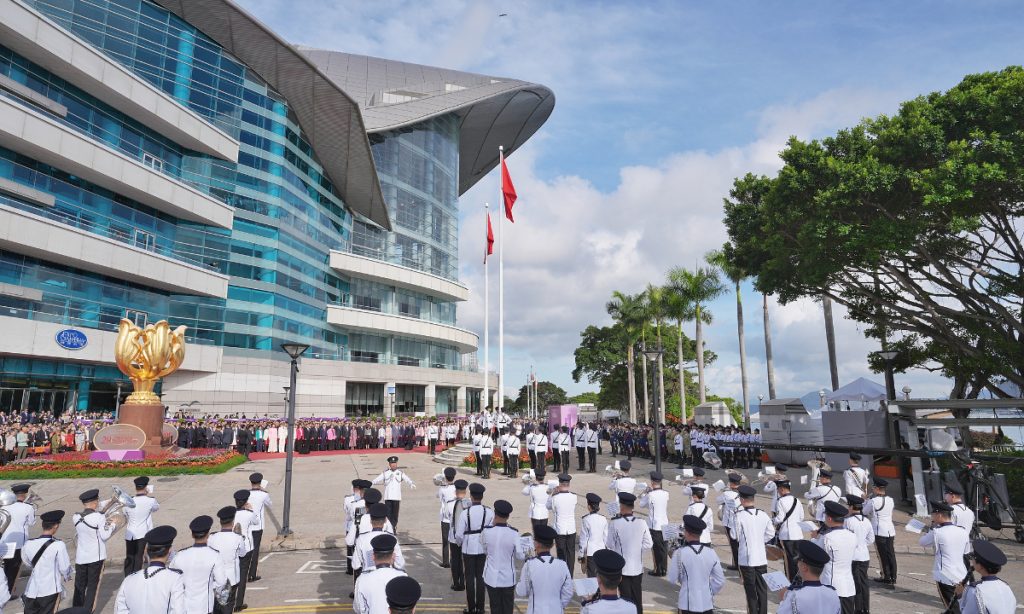
To celebrate the 29th anniversary of Hong Kong's return to the motherland and the establishment of the Hong Kong Special Administrative Region (HKSAR), a flag-raising ceremony was held on Wednesday morning at Golden Bauhinia Square in Wan Chai, attended by local officials including HKSAR Chief Executive (CE) John Lee Ka-chiu and former CEs Leung Chun-ying, Donald Tsang and Carrie Lam, as well as distinguished members of the community and representatives of the disciplined services, according to local media reports.
An honor guard escorted Chinese national flag and the HKSAR regional flag to the flagpoles for the flag-raising ceremony. As the flags were raised, all guests stood solemnly facing the national flag and the regional flag.
During the ceremony, the Police Silver Band performed, while the flag-guarding team and ceremonial guard marched in using Chinese-style foot drill. The performance of the national anthem was led by a guest vocalist, according to media reports.
Several helicopters from the HKSAR government Flying Service flew over Victoria Harbour carrying the national flag and the HKSAR regional flag. Meanwhile, fireboats and vessels from the Hong Kong Police Force performed a water salute off the Hong Kong Convention and Exhibition Centre, spraying jets of water in tribute.
Following the flag-raising ceremony, the HKSAR held a reception at the Hong Kong Convention and Exhibition Centre in Wan Chai. During the event, a video message from Hong Kong astronaut Lai Ka-ying, recorded aboard the Tiangong space station, was played, with her speaking in both Putonghua and Cantonese, local media RTHK reported.
Lai Ka-ying, a Hong Kong local, made history as the first member of China's fourth batch of astronauts to take on an in-orbit mission, as well as the first female payload specialist from the Hong Kong and Macao special administrative regions to join a national manned space program.
Speaking first in Putonghua, Lai said she was deeply honored to display the HKSAR flag aboard the space station as a gesture of profound gratitude to the country and of her best wishes for Hong Kong, RTHK said.
She then switched to Cantonese, saying that being able to speak from space on this special occasion vividly demonstrated the valuable opportunities Hong Kong enjoys under the principle of "One Country, Two Systems," with the support of the motherland.
As Hong Kong's first astronaut, Lai said she has felt immense pride while carrying out her mission as part of China's space program. She added that she has witnessed firsthand how the country's efforts to build itself into a leading space power not only advance human civilization but also contribute to creating a better future for humanity.
In his keynote address at the reception, HKSAR CE John Lee said that over the past four years, his administration has transformed the government's culture by establishing a "results-oriented" approach, tackling problems that had accumulated over many years, according to local media reports.
Lee said his government had restored security and stability to Hong Kong by completing the historic local legislation of Article 23 of the Basic Law of the HKSAR strengthening the city's national security framework, and fully implementing the principle of "patriots administering Hong Kong." He added that reforms to the governance system have also begun to produce tangible results.
Looking ahead, Lee said the HKSAR government is drafting Hong Kong's first-ever Five-Year Plan, with public consultation already underway.
Consultation on this year's Policy Address also began this week. He said the Five-Year Plan will provide strategic direction for Hong Kong's economic and social development, while future Policy Addresses will align with the plan by setting measurable targets, reporting progress, and introducing policy initiatives tailored to changing circumstances each year.
The most significant change in Hong Kong in recent years has been the profound transformation of its governance system, Willy Fu, a law professor who is also the director of the Chinese Association of Hong Kong & Macao Studies, told the Global Times on Wednesday.
The implementation of the National Security Law for Hong Kong and the completion of legislation under Article 23 of the Basic Law of the HKSAR have established a solid legal safeguard for protecting national security. At the same time, the principle of "patriots administering Hong Kong" has been fully implemented, ensuring that the city's governing power is firmly in the hands of patriots, Fu noted.
The HKSAR government has also become more proactive in adapting to new circumstances, responding to challenges and pursuing reform by deepening governance reforms and improving administrative efficiency, bringing an end to the previous passive approach toward safeguarding national security and governance, Fu added.
Meanwhile, the greatest constant is the unwavering implementation of the "One Country, Two Systems" principle and the preservation of Hong Kong's unique advantages.
"The central government's commitment to 'One Country, Two Systems' remains steadfast while Hong Kong's status as an international financial, trade, and shipping center remains unchanged. Its strengths, including the common law system, an open and free market, and internationally connected professional services, continue to be maintained, and the rights and freedoms enjoyed by Hong Kong residents under the law remain fully protected," he said.
Also, on the occasion of the 29th anniversary of the establishment of the HKSAR, a total of 466 people who have made significant contributions to Hong Kong in different areas were awarded by the CE, according to the HKSAR government.
Late firefighter Ho Wai-ho, who made the ultimate sacrifice in the Wang Fuk Court blaze in November 2025, was posthumously awarded the Medal for Bravery (Gold). The HKSAR government said the chief executive described Ho as deserving of the highest honor and respect.
According to the HKSAR government website, the HKSAR government on Wednesday held the launch ceremony for a series of events marking the 105th anniversary of the founding of the Communist Party of China (CPC) at the Hong Kong Convention and Exhibition Centre.
Lau Siu-kai, consultant to the Chinese Association of Hong Kong and Macao Studies, told the Global Times that after the central government restored order in Hong Kong and anti-China forces seeking to destabilize the city were eliminated, Hong Kong has been able to actively, smoothly, and effectively promote national education, including patriotic education. He said that in the past, the CPC was smeared due to interference from both external and internal hostile forces.
Lau noted that in recent years, under Hong Kong's new political landscape, the advancement of national education has helped improve public understanding of and respect for the CPC. "This has enabled the HKSAR government to organize a wide range of activities aimed at enhancing Hong Kong society's understanding of and confidence in the CPC."
The Turpan city of Northwest China's Xinjiang Uygur Autonomous Region may see temperatures exceed 50 C this week as an intense heatwave sweeps across parts of China, with Xinjiang and western Gansu Province to see unusually high temperatures, North China and the Huanghuai region (including Henan, Anhui, Jiangsu and Shandong provinces) expecting new highs of the year, and South China bracing for extremely muggy conditions, meteorological forecasts showed, according to the CCTV News.
Turpan, the hottest city in China during summer, is expected to see maximum temperatures remain at or above 45 C from Tuesday through July 5, with the mercury possibly reaching 49 C on July 2, which could tie the highest temperature of local record. In some parts of the Turpan Basin, temperatures could climb to between 50 C and 52 C, potentially challenging China's highest measured temperature record of 52.2 C, according to CCTV.
According to a report from Xinjiang regional news portal ts.cn, from June 30 to July 5, and possibly until July 8 in southern and eastern Xinjiang, most parts of the region are forecast to experience the strongest high-temperature spell since the start of summer. Maximum temperatures in some areas are expected to exceed 40 C.
The heatwave is expected to last long and engulf a wide range, requiring heightened precautions against snowmelt-triggered and mixed-source floods, as well as heat-related damage to crops, livestock and public health, per ts.cn.
According to an article from the WeChat account affiliated to China Meteorological Administration, under the influence of a warm high-pressure ridge, Xinjiang region is expected to experience a prolonged spell of sunny and scorching weather. The high-pressure system is large in scale, slow-moving and may even remain nearly stationary, with sinking air inside the system helping to suppress cloud formation and maintain clear skies. In meteorology, this kind of persistent high-pressure system that traps heat and drives continuous warming is known as a "heat dome."
The heatwave comes shortly after the summer solstice, when the Northern Hemisphere sees long daylight hours and a high solar angle, resulting in intense solar heating. Combined with the warm high-pressure system, these conditions are expected to bring a prolonged and intense heatwave to Xinjiang region, according to the article.
High temperatures are also expected to become more frequent this week across southern parts of North China and the Huanghuai region, with many areas likely to record their highest temperatures so far this year. By July 4, hot weather is forecast to affect central and southern Shanxi, southern Hebei, central and northern Henan, and western and northern Shandong. In parts of southern Hebei, maximum temperatures may exceed 40 C. Northern Henan is expected to see the most frequent high-temperature conditions, according to CCTV News.
The warming trend in northern China will also be accompanied by rising humidity. In Zhengzhou, for example, temperatures around Friday evening are expected to remain above 35 C, with relative humidity reaching around 60 percent, making conditions feel particularly muggy and uncomfortable, said the report.
The report also noted that the public is advised to take measures to keep indoor spaces cool, use sun protection when going outdoors, and avoid outdoor activities during the hottest hours of the afternoon. People should also remain alert to the risks of heatstroke and heat-related illnesses, including potentially life-threatening heatstroke.
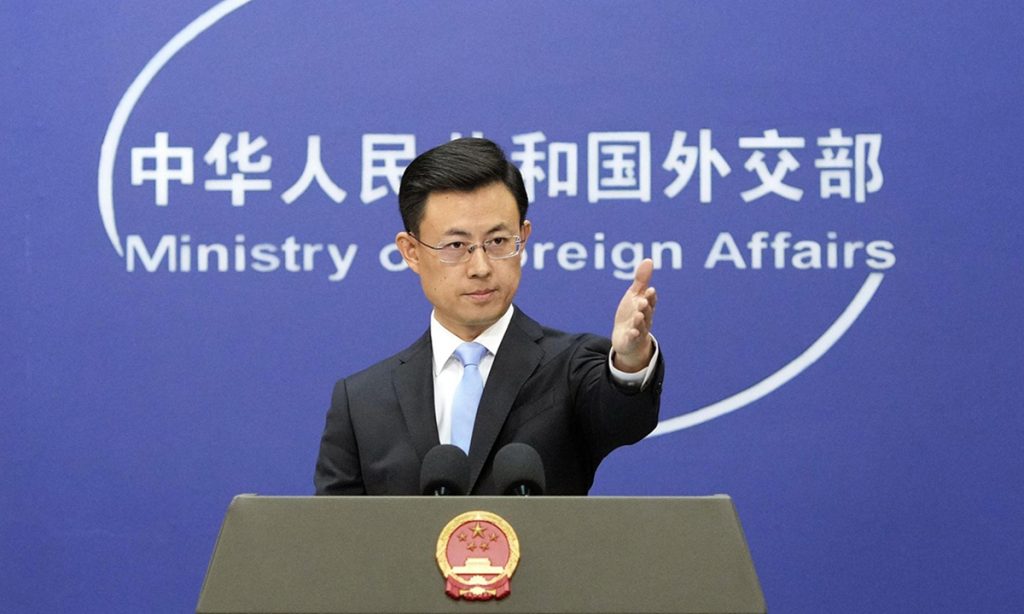
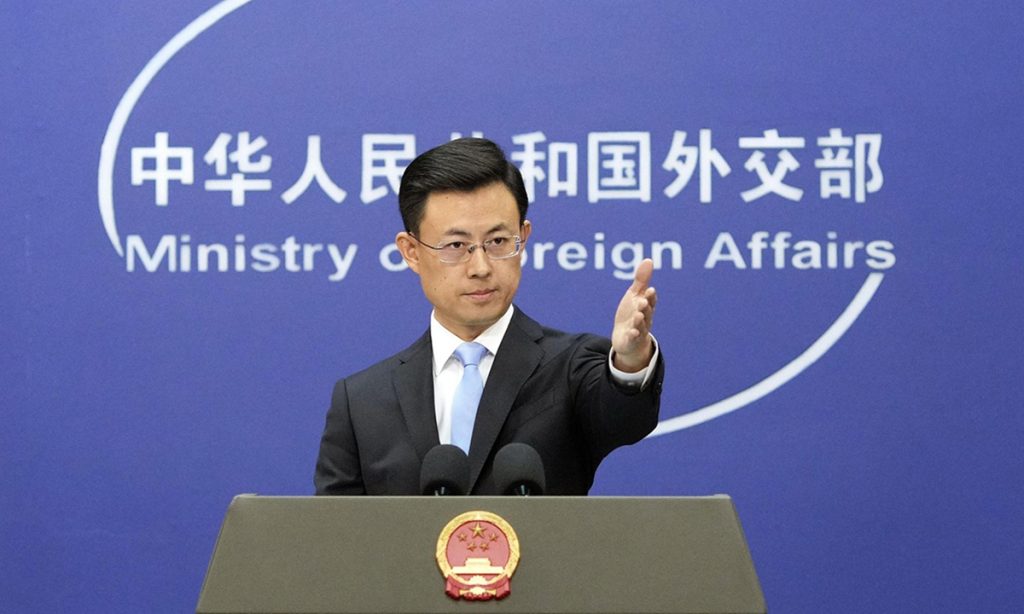
China hopes that the cooperation between relevant country and Pacific nations will be truly conducive to the development and stability of the Pacific islands region. The cooperation should not target any third party, still less be used as an excuse for geopolitical contest, Chinese Foreign Ministry spokesperson Guo Jiakun said on Monday.
He made the remarks at the Monday regular press conference, in response to Australia and Vanuatu on the same day signing an economic and security agreement that prohibits the establishment of any foreign military base on the Pacific island nation's territory. Australian officials have previously expressed concern that China is seeking an expanded security presence in the region, including in Vanuatu.
China always upholds the principles of mutual respect, equality, mutual benefit, openness and inclusiveness in carrying out practical cooperation in various fields with Vanuatu and other Pacific nations, Guo said.
According to the Australian Financial Review (AFR), Australian Prime Minister Anthony Albanese and Vanuatu's leader Jotham Napat signed the Nakamal agreement in Canberra on Monday, almost a year after a planned signing ceremony in Port Vila collapsed over concerns Vanuatu would surrender too much sovereignty to Australia, particularly over foreign investment decisions.
Certain Western media outlets including the AP and the Australian Broadcasting Corporation are falling back on their familiar rhetoric, hyping supposed competition between China and Australia for influence across the region when reporting on the Australia-Vanuatu agreement.
Chen Hong, director of the Asia Pacific Studies Centre of East China Normal University, told the Global Times on Monday that such hype from Western media largely stems from their tendency to view Pacific island states through a Cold War-style geopolitical lens, treating sovereign nations merely as bargaining chips for major-power rivalry.
Such narratives overlook the region's most pressing reality: For Pacific island countries, the gravest security challenges lie not in purported competition over military outposts or bloc standoffs, but existential hurdles including natural disasters, energy shortages and inadequate public services that hinder their survival and development, Chen stressed.
China's cooperation with Vanuatu centers on the country's core development priorities, with a sharp focus on livelihood projects that deliver tangible results, enabling local communities to witness meaningful progress spanning transport access, stable power supply, healthcare, education and vocational training, Chen said. "This strong people-centered bond renders bilateral cooperation far less susceptible to outside hyping narratives," he said.
Notably, Australia and Vanuatu have agreed to water down key clauses clearly aimed at limiting Chinese investment in Vanuatu's ports, airports and telecommunications by blocking "third party involvement" in critical infrastructure which could affect either country or "the region's security interest," according to the Australian Broadcasting Corporation.
Albanese said on Monday the updated Nakamal agreement would require Vanuatu to consult on any third-party agreement in critical infrastructure. However, the text of the deal shows Australia would no longer have veto rights over critical infrastructure investment in Vanuatu, per the AFR.
Chen said that Vanuatu's efforts to adjust core provisions with notable exclusionary inclinations may well reflect its consistent commitment to upholding national sovereignty and preserving autonomy over its development roadmap, as it hopes to avoid being cornered into taking sides between China and Australia.
Chen noted that from Vanuatu's perspective, key infrastructure covering ports, airports, telecommunications and energy underpins its economic growth, disaster management and progress in people's well-being; such essential national assets are hardly areas where outside parties ought to draw arbitrary investment limits and restrain collaborative development under the guise of security concerns.
Australia's willingness to adjust relevant provisions also points to a reality that Canberra needs to face, which is that Pacific island nations are no longer geopolitical pieces that external powers can manipulate at will. While outside countries may offer development support to these islands, such aid and cooperation should not translate into exclusive control, nor should bilateral partnerships be burdened with political strings that limit collaboration to a single partner only, the expert said.
At the Monday press conference, spokesperson Guo also responded to two follow-up questions regarding a strategic cooperation pact that China and Vanuatu are slated to sign, specifically, when it will be signed and whether the text of the deal with China would be released once it is signed in the interest of transparency.
For the first question, Guo said that China's cooperation with Vanuatu is based on mutual respect, equal consultation, mutual benefit, openness and inclusiveness. China will, in light of the aspirations and needs of Vanuatu, continue expanding friendly exchanges and cooperation in various fields to the benefit of our two countries and peoples, Guo added.
On the second question, Guo said China's cooperation with Pacific island nations is fair and square. "Our cooperation is not imposed on anyone, nor targets any third party, and has been sincerely received by the people in the region," he said, adding that China always handles the documents on bilateral cooperation with Pacific island nations on the basis of friendly consultation.
Public approval rate for Japanese Prime Minister Sanae Takaichi's cabinet fell by 5.1 percentage points from the previous month to 54.3 percent in June, hitting the lowest level since she took office last October, a poll by Jiji Press showed.
Conducted from June 12 to 15 with 2000 people aged 18 or over nationwide, the June survey by the Japanese news outlet also suggested that the proportion of respondents who oppose the Takaichi cabinet rose by 2.5 percentage points to 22.2 percent, the highest since Takaichi took office.
In terms of the political parties, the ruling Liberal Democratic Party (LDP) maintained the top support rate at 22.8 percent, but the figure fell by 5.0 points from the previous month.
Besides Jiji Press, multiple Japanese media outlets have noted the downward trend in approval ratings for Takaichi's cabinet.
Earlier this month, an NHK poll released on June 8 shows that the approval rate for Takaichi cabinet dropped 1 percentage point from last month to 60 percent. The disapproval rate is 26 percent, up 3 percentage points.
A nationwide opinion poll carried out by the Mainichi Shimbun on May 23 and 24 put cabinet support at 50 percent, logging the third straight monthly decline.
"While Takaichi's top-line support levels remain robust, though, the nature of support for the prime minister is nevertheless changing," Katsuhiro Yoneshige, president of news venture JX Press Corp, wrote in an opinion piece for Nippon.com.
Citing surveys from political survey website Go2senkyo.com and the JX News Agency, the article noted that since Takaichi's inauguration, the level of enthusiasm for Takaichi's cabinet has dropped among the working-age generation (those in their twenties to fifties). In May, those who "strongly support" the government registered only 30 percent, down from 50 percent six months prior in this broad and critically important demographic.
The Jiji Press attributed the sliding approval figures to social media videos released by Takaichi's campaign that smeared rival candidates during electoral races, including last year's LDP leadership contest. There are some other Japanese media outlets attributed the decline in Takaichi's approval ratings in recent months to Japan's pervasive cost-of-living crunch and growing alarm over surging energy prices fueled by tensions across the Middle East.
Earlier this month, a Mainichi Shimbun survey found that the young age group, which once held high hopes for the Takaichi administration, has turned critical of her leadership.
While the Takaichi cabinet is mulling a consumption tax cut on food and beverages to tackle soaring prices, the measure has sparked worries that it may fail to deliver its intended effects. Even if rolled out as a temporary policy, critics fear it could become permanent and trigger deterioration in public finances, according to the Bloomberg Japan.
Lü Chao, a professor at the Liaoning Academy of Social Sciences, told the Global Times on Saturday that economic and livelihood concerns remain the core benchmark for Japanese voters to assess the performance of the Takaichi cabinet.
"Takaichi made sweeping campaign promises to improve public livelihood and address economic hardships, but she has largely failed to deliver the commitment," the expert pointed out. "Furthermore, her provocative policies toward China have inflicted substantial economic losses on Japan's business sector, fueling discontent among local industrial and commercial communities."
Takaichi's awkward showing on the diplomatic circuit has also drawn fierce backlash from Japanese citizens. On June 18, a clip capturing Takaichi being largely ignored by fellow world leaders ahead of an official G7 group photo went viral across X.
"Takaichi is isolated, barely able to hold a conversation with anyone. At one point, she even pretended people were talking to her when no one had approached her at all—utterly deranged behavior… All her multiple scandals have become widely known overseas… There is no way world leaders will treat her with genuine respect," commented Japanese netizen with account named Yuma Tsuhara.
Separately, citing France Inter, Japan's Nikkan Gendai reported on Friday that US President Donald Trump clashed with Takaichi during a working dinner at the recently concluded G7 Summit, prompting other world leaders to step in and mediate. The tense exchange erupted after Trump talked about a US strike on Iran and drew a direct parallel between the operation and Japan's attack on Pearl Harbor in 1941.
Ichiro Ozawa, a former member of Japan's House of Representatives, pinned a June 5 report from the Mainichi Shimbun to the top of his X timeline. The article noted approval ratings for the Takaichi cabinet had slipped below 50 percent among young voters for the first time.
His accompanying comment read: "Drive prices ever higher, let the population dwindle further, line pockets with unending illicit slush funds, wear away public morality little by little, dismantle this nation piece by piece, and ultimately lead it to collapse… This is precisely what supporting the LDP means. You are simply tightening the noose around your own neck… It is time people wake up."
According to Lü, while achieving negligible progress in economic recovery and public welfare improvement, the Takaichi cabinet has aggressively advanced far-right and neo-militarist agendas. "Such radical policies have not only exacerbated domestic social divisions and damaged Japan's international reputation, but also undermined the country's overall security environment."
The Chinese side hopes to take this visit as an opportunity to work with Bangladesh's new government to strengthen strategic communication, carry forward traditional friendship, advance high-quality Belt and Road cooperation, expand exchanges and cooperation across all sectors, boost coordination on multilateral affairs, and promote the China-Bangladesh comprehensive strategic cooperative partnership to new heights, Chinese Foreign Ministry spokesperson Guo Jiakun said at a press briefing on Monday, in response to media inquiries over the upcoming China visit by Bangladesh's Prime Minister Tarique Rahman.
At the invitation of Premier of the State Council Li Qiang, Prime Minister of the People's Republic of Bangladesh Tarique Rahman will pay an official visit to China from June 24 to 26, a Chinese Foreign Ministry spokesperson announced on Monday.
According to Guo, the visit marks Tarique's first visit to China since he assumed office. During the visit, Chinese leader will hold meetings and talks with him to conduct in-depth exchanges of views on bilateral ties as well as international and regional issues of mutual concern, charting the course for the growth of bilateral relations.
Tarique will also attend the Summer Davos forum, or the 17th Annual Meeting of the New Champions of the World Economic Forum (WEF), in Dalian, Northeast China's Liaoning Province, he added.
The spokesperson noted that China and Bangladesh are time-honored friendly neighbors and comprehensive strategic cooperative partners. In recent years, guided by the strategic vision of leaders of the two countries, China-Bangladesh relations have kept forging ahead, political mutual trust has deepened steadily, and fruitful outcomes have been achieved in practical cooperation, delivering tangible benefits to the two peoples.
Chinese top diplomat Wang Yi on Tuesday called on BRICS countries to join forces and respond to security challenges together.
When meeting Russian Security Council Secretary Sergei Shoigu in New Delhi, India, Wang said that the bloc ought to do its part in safeguarding the security environment, and add more certainty to a turbulent world.
Wang, also a member of the Political Bureau of the Communist Party of China Central Committee and director of the Office of the Central Commission for Foreign Affairs, is in New Delhi for the 16th Meeting of BRICS National Security Advisors and High Representatives on National Security.